
A direct look.
Colonoscopy lets a clinician examine the lining of the colon and rectum directly.NCI evidence ↗
A CASE FOR PREVENTION
Colonoscopy can find and remove precancerous polyps during the same exam. That’s the reason behind Colonoscopy First.NCI evidence ↗
For adults due for screening who can safely undergo colonoscopy and have access to a high-quality exam. Average risk? Start at 45.
The cancer number isn’t the whole story.
FDA Cologuard Plus labeling · PMA P230043 · One screening round.FDA evidence ↗
A screening test can look for warning signs.
Colonoscopy can also act on what it finds.
01 / WHY COLONOSCOPY
Some polyps can develop into cancer. Finding and removing them is a central goal of prevention.NCI evidence ↗
Colonoscopy lets a clinician examine the lining of the colon and rectum directly.NCI evidence ↗
Many precancerous polyps can be removed during that same exam. Large or complex growths may need another procedure.NCI evidence ↗
A randomized trial found fewer colorectal cancers after an invitation to colonoscopy. The outcome details matter.NordICC evidence ↗
Read what the trial showed →Colonoscopy is not perfect: it can miss lesions, and its quality depends on preparation and the examination itself. Bleeding, perforation, and sedation-related complications can occur.Screening guideline ↗
02 / THIS INCLUDES YOU
Screening belongs in your 40s. For adults at average risk without symptoms, the recommended starting age is 45. Feeling well is a reason to screen on schedule.Screening guideline ↗
U.S. incidence trend, ages 20–49, 2013–2022. This is a change in the cancer rate, not an individual’s chance of cancer.Read the cancer trend source ↗
Higher-risk precancerous polyps called advanced adenomas were found in 165 of 4,380 adults aged 45–49 at first screening colonoscopy. One U.S. health system, 2021–2024.Read the screening study ↗
Cancer trends and precancer findings answer different questions. Explore what the studies establish—and where the evidence has limits.
Read the age 45 evidence03 / THE CAMPAIGN
The campaign in pictures.
Explore the posters, reels, and evidence.
CANCER ≠ PRECANCER
Cologuard Plus detected 43.3% of participants with advanced precancerous lesions in the FDA study analysis. The 95.3% cancer figure describes a different group.FDA evidence ↗
A captioned, 24-second look at the poster’s message.
Figures refer to Cologuard Plus, not the original Cologuard test. BLUE-C was funded by Exact Sciences, the manufacturer. See denominators and study context ↗
Open an image for its caption and the evidence behind it.
21 seconds · Sound-free · On-screen text
A 100-person illustration, not a separate trial: all 100 already have advanced precancer. Applying the published BLUE-C sensitivity of 43.4%, about 43 would test positive and about 57 would test negative in one screening round. It does not mean 57% of all screened adults have missed disease or that 57% of negative tests conceal precancer.
Colonoscopy can find and remove detected precancerous polyps during the same exam. It can also miss lesions and has preparation, sedation, bleeding, perforation, and other burdens or risks. Stool-based screening remains a guideline-supported option; a positive stool test requires colonoscopy. Choose a screening plan you can complete with your clinician.
BLUE-C was funded by Exact Sciences, maker of Cologuard Plus; multiple published-study authors were company employees. Single-round test performance does not establish lifetime screening outcomes.
04 / KNOW THE DIFFERENCE
Convenience matters. So does understanding what happens before—and after—a result.
| What matters | DIRECT EXAMINATIONColonoscopy | STOOL DNA TESTINGCologuard / Plus |
|---|---|---|
| How it works | A camera examines the colon and rectum. | A stool sample is checked for DNA and blood signals. |
| Removing polyps | Can remove them during the exam. | Cannot remove polyps. |
| Preparation & visit | Bowel preparation, usually sedation, and a ride home. | Home collection; no bowel preparation or sedation for the stool test. |
| If something is found | Removal or biopsy may be possible; further care depends on findings. | A positive result requires colonoscopy. |
| What to keep in mind | Can miss lesions; bleeding, perforation, and sedation risks. | Can miss cancer and precancer; false positives occur. Repeat testing and follow-up matter. |
General comparison, not a head-to-head cancer-outcome trial. Sources: NCI, FDA labeling, USPSTF.
This campaign favors high-quality colonoscopy for average-risk adults who are due for screening, medically appropriate, willing, and able to access it. Stool tests are guideline-supported options and may help people complete screening. A positive stool test followed by colonoscopy can also lead to precancer removal.Screening guideline ↗
COMMON CONCERNS / STRAIGHT ANSWERS
Cost. Time. Prep. Embarrassment. Real concerns deserve clear answers—and a practical next step.
For people who are due for screening. Your symptoms, health, and personal or family history may change the right plan for you.
Precancerous polyps and early colorectal cancer can be present without symptoms. Screening looks for problems before you notice them. Colonoscopy can also remove detected precancerous polyps during the same exam, before they have the chance to become cancer.
Your next step: If you’re due for screening, don’t wait for symptoms. If you already have rectal bleeding, persistent bowel changes, or unexplained weight loss, contact your clinician for evaluation—even after a negative stool test.
Most colorectal cancers occur in people without a family history of the disease. Routine screening recommendations already include people at average risk. A family history can mean starting earlier; its absence does not mean skipping screening.
Your next step: Average-risk screening generally begins at 45. Review your age, previous tests, health, and family history with your clinician to find out whether you’re due.
Many U.S. health plans cover eligible, in-network screening colonoscopy without a copay or deductible. But costs depend on your plan and why the test is being done. An exam for symptoms may be covered differently. Medicare can still require coinsurance when a polyp or other tissue is removed.
Your next step: Ask your insurer and the endoscopy center for an estimate covering the doctor, facility, anesthesia, pathology, and prep—including what happens if a polyp is removed. If you’re uninsured or the cost is a barrier, ask about financial assistance or local screening programs.
Federal preventive-care coverage guidance ↗Medicare coverage ↗
Plan for bathroom access during prep and time away from work on the procedure day if you receive sedation. You’ll need a ride home. Many people resume usual activities the next day, but follow your team’s discharge restrictions.
After a normal, high-quality colonoscopy, an average-risk person can usually wait 10 years until the next screening colonoscopy. Findings, exam quality, symptoms, or risk factors can change that interval.
Your next step: Ask about appointment times that fit your work and caregiving schedule, a work note, and the center’s escort requirements. Arrange the ride before starting prep.
Frequent bathroom trips and changes to eating and drinking are part of prep. Leftover stool can hide polyps and may lead to an earlier repeat exam. Current guidance favors splitting the prep into doses; lower-volume regimens may be suitable for some people.
Your next step: Ask which prep fits your health and schedule, especially if you’ve struggled before. Lower-volume prep still requires additional clear liquids. Follow your team’s exact diet, medication, and timing instructions, and call if you can’t finish.
2025 multisociety prep guidance ↗NIH: preparing for colonoscopy ↗
Yes—a flexible camera passes through the anus to examine the colon. That direct access also lets the doctor remove polyps when feasible. Sedation is commonly used to help with comfort; how deeply you’re sedated and what you remember can vary.
Your next step: Tell the team what worries you—pain, embarrassment, loss of control, or a past experience. Ask how they will protect your privacy, what sedation to expect, and what accommodations are possible. You deserve that conversation before consenting.
Colonoscopy can miss lesions and can cause complications, including bleeding, a tear in the colon, or a reaction to sedation. Your health and the treatment performed affect your risk. Ask your clinician how the benefits and risks apply to you.
If colonoscopy remains out of reach or you decide against it, ask about another recommended screening option. Stool-based screening can be a useful choice, but it cannot remove a polyp, needs repeat testing, and a positive result requires colonoscopy. Make a plan you can complete.
Procedure risks ↗ · Screening options ↗ · Compare the approaches ↗
Sources checked September 27, 2026 · U.S. coverage information; confirm your own plan’s terms.
05 / EVIDENCE & SOURCES
Colonoscopy First is an advocacy campaign, but the evidence comes first. See what each study measured, what it did not prove, how denominators change meaning, and which campaign claims rely on it.
Original source check · September 26, 2026In the FDA primary-effectiveness population (18,911 participants), Cologuard Plus was positive in 81 of 85 participants with colorectal cancer (95.3%) and 849 of 1,962 with advanced precancerous lesions (43.3%).FDA evidence ↗
These are one-round sensitivities in two disease groups. “Advanced precancerous lesions” means the higher-risk growths defined in the study, not all polyps. The figures do not describe your risk after a negative test or prove a difference in lifetime outcomes.
The FDA primary-effectiveness analysis and the published BLUE-C paper used different analysis populations. FDA labeling reports 95.3% colorectal-cancer sensitivity and 43.3% advanced-precancer sensitivity. The published BLUE-C analysis reports 93.9% and 43.4%. Colonoscopy First uses each pair only with its corresponding source and does not treat them as interchangeable. BLUE-C was funded by Exact Sciences.
In NordICC, adults aged 55–64 were randomized to a colonoscopy invitation or usual care. At 10 years, colorectal cancer risk was 0.98% versus 1.20%: an 18% relative reduction and a 0.22 percentage-point absolute reduction. Only 42% of invited participants underwent screening.NordICC evidence ↗
The primary analysis did not show a statistically significant reduction in colorectal cancer mortality. This trial compared an invitation with usual care; it did not compare colonoscopy with Cologuard.
Yes. They can identify people who need colonoscopy, where polyps may be removed. In COLONPREV, repeated FIT screening met the trial’s noninferiority criterion for colorectal cancer mortality at 10 years compared with a colonoscopy-invitation strategy.COLONPREV evidence ↗
A 2026 post hoc analysis among people who started screening also found similar weighted 10-year colorectal cancer incidence and all-cause mortality under sustained FIT versus one-time colonoscopy. This secondary analysis is subject to additional assumptions.COLONPREV sustained-strategy analysis ↗
FIT is a stool blood test, not Cologuard. These results should not be presented as a direct Cologuard comparison, or dismissed simply because participation differed. Single-round detection figures do not establish which strategy produces the best lifetime outcome for every patient.
For average-risk adults without symptoms, the USPSTF recommends screening from age 45 through 75. Screening from 76–85 is individualized based on health, prior screening, and preferences. A normal, high-quality colonoscopy commonly allows a 10-year interval for an average-risk person.Screening guideline ↗
Symptoms, prior polyps, inflammatory bowel disease, or family history can change the plan. Rectal bleeding or other concerning symptoms need medical evaluation, even after a negative stool test.
Primary studies, FDA labeling, guidelines, and the limits that matter.
Average-risk adults should begin screening at age 45. Stool-based tests and colonoscopy are guideline-supported options; positive non-colonoscopy tests require timely colonoscopy.
Important context: Recommended does not mean identical in precursor detection, burden, or same-session treatment capability.
95.3% colorectal-cancer sensitivity.
43.3% advanced-precancer sensitivity.
FDA primary-effectiveness population. One screening round.
Important limit: This is a different analysis set from the published BLUE-C paper.
93.9% colorectal-cancer sensitivity.
43.4% advanced-precancer sensitivity.
Published diagnostic-accuracy analysis. One screening round.
Important limit: Not a randomized trial of long-term colorectal-cancer incidence or mortality.
Disclosure: Funded by Exact Sciences; multiple authors were company employees.
Among 16,414 negative Cologuard Plus results, 1,113 people (6.8%) had advanced precancer found at colonoscopy.
Among 1,962 people who had advanced precancer, 1,113 (56.7%) tested negative.
Important limit: 6.8% is not sensitivity. 56.7% uses a different denominator.
Colonoscopy directly examines the colon and can remove detected precancerous polyps during the same exam.
Important limit: Colonoscopy can miss lesions and has preparation, sedation, bleeding, perforation, and other burdens/risks.
Organized stool-based screening can produce excellent population outcomes.
COLONPREV: repeated FIT invitation achieved higher participation and was noninferior to colonoscopy invitation for 10-year colorectal-cancer mortality.
Kaiser: organized annual FIT plus colonoscopy follow-up was associated with substantial improvements in screening, incidence, and mortality.
Important limit: These studies used FIT, not Cologuard. Program effectiveness is not the same as intrinsic single-round test performance.
Seen one of our posts? Start here.
Primary research, FDA documents, and clinical guidance used throughout Colonoscopy First.
National Cancer Institute
Direct examination, polyp removal, screening tradeoffs and limitations.
U.S. Food and Drug Administration
Indication, primary-effectiveness analysis, test performance, and negative-result findings.
Imperiale TF, Porter K, Zella J, et al. N Engl J Med. 2024;390:984–993.
Published BLUE-C diagnostic-accuracy study.
Wolf AMD, Hoffman RM, Walter LC, et al. CA Cancer J Clin. 2026;76:e70083.
Screening options, starting age, informed choice, and follow-up.
Bretthauer M, et al. N Engl J Med. 2022.
NordICC randomized colonoscopy-invitation trial.
U.S. Preventive Services Task Force
Eligibility, screening strategies, intervals, benefits, and harms.
Castells A, et al. Lancet. 2025;405:1231–1239.
Randomized colonoscopy-vs-biennial-FIT invitation strategy.
Castells A, et al. Gut. 2026.
Post hoc analysis among screening initiators.
Levin TR, Corley DA, Jensen CD, et al. Gastroenterology. 2018;155:1383–1391.e5.
Kaiser organized annual FIT plus colonoscopy program.
Estes C, Vahdat V, Johnson H, et al. J Clin Oncol. 2026;44(suppl 16):e15647.
Publication-only abstract reporting post-positive adenoma yield; Exact Sciences funded.
Siegel RL, Wagle NS, Star J, et al. CA Cancer J Clin. 2026;76:e70067.
U.S. colorectal-cancer incidence and mortality trends by age, including the 2013–2022 trend in adults ages 20–49.
Lee JK, Jensen CD, Hendel J, et al. JAMA. 2025;334:449–452.
First screening colonoscopy, 2021–2024: advanced adenomas in 165 of 4,380 adults ages 45–49 (3.8%).
Evidence boundaries matter. FIT studies are not automatically evidence for stool DNA testing. Post-positive colonoscopy yield is not screening-test sensitivity. Invitation-level screening outcomes are not the same as completed-test performance. Manufacturer funding is disclosed but does not by itself invalidate a study.
Colonoscopy First is independent physician-led education with an explicit point of view: for screening-eligible, average-risk adults who are medically appropriate, willing, and have timely access, this campaign favors high-quality colonoscopy first. Advocacy does not change the evidence standard.
Major quantitative claims are checked against primary studies, FDA documents, guidelines, and other high-quality evidence. We distinguish colorectal-cancer detection from advanced-precancer detection; single-round test performance from longitudinal outcomes; screening-test sensitivity from findings after a positive test; and invitation-level program outcomes from completed-test performance.
Evidence that supports stool-based screening is included when relevant. Organized FIT programs such as COLONPREV and Kaiser demonstrate that participation, repeat testing, infrastructure, and completed follow-up colonoscopy can produce substantial population benefit. FIT evidence is not automatically attributed to stool DNA testing.
Colonoscopy First is not sponsored by or presented on behalf of a medical practice, hospital, health system, professional society, screening-test manufacturer, or endoscopy-equipment manufacturer unless specifically stated. Material study funding, manufacturer employee authorship, and other relevant conflicts are disclosed when they affect evidence used by the campaign.
Colonoscopy First provides general education, not individualized medical advice. Screening decisions should account for personal health, family history, prior findings, procedure risks, preferences, and access. “Colonoscopy First” is this campaign’s evidence-based advocacy position—not a claim that every guideline requires colonoscopy first or that stool-based screening has no legitimate role.
Evidence last reviewed: September 27, 2026.
Major claims will be re-reviewed when pivotal evidence, FDA labeling, or major colorectal-cancer screening guidelines materially change.
Illustrative imagery: Campaign imagery may be created or modified with generative tools. Medical illustrations that could reasonably be mistaken for actual clinical images are labeled as illustrative or AI-generated.
1 in 2
colorectal cancer diagnoses before age 50 occur at ages 45–49.
For people at average risk, screening starts at 45. Colonoscopy directly examines the colon and can remove detected precancerous polyps during the same exam—helping prevent cancer before it starts.
For people who are medically appropriate, willing, and have timely access, our campaign favors high-quality colonoscopy. If it is not a workable option, choose another recommended screening test with your clinician. Don’t put screening off indefinitely.
For those who can, Colonoscopy First.
Symptoms or elevated risk may need earlier evaluation. That is different from routine screening for everyone under 45.
YOUR NEXT CONVERSATION
If you’re due for screening, ask your clinician whether a high-quality colonoscopy is right for you.
Discuss your health, family history, prior results, procedure risks, and practical barriers. Make a plan you can complete.
Review the differences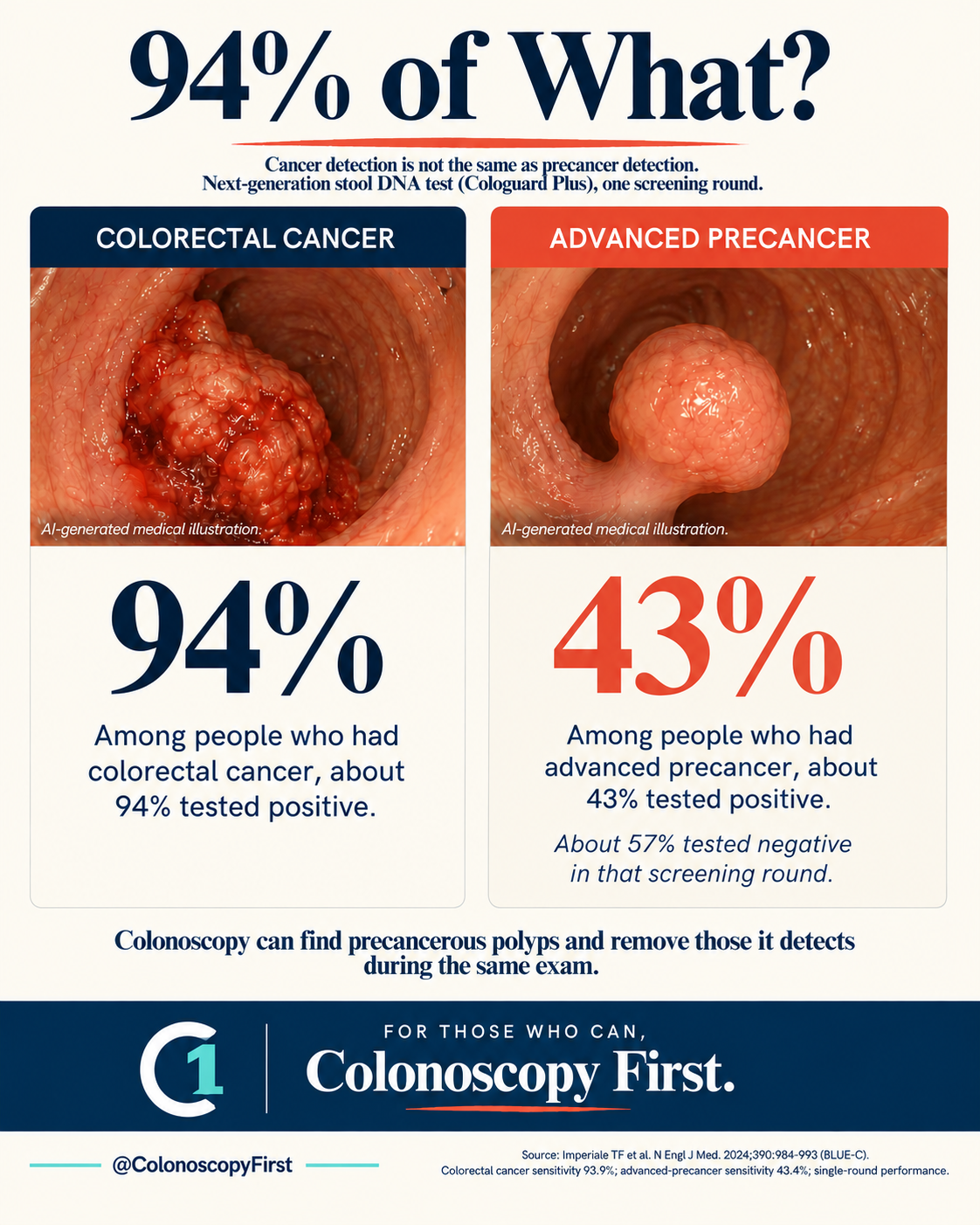
The published BLUE-C analysis of next-generation stool DNA testing (Cologuard Plus) reported 93.9% colorectal-cancer sensitivity and 43.4% advanced-precancer sensitivity in one screening round. These round to 94% and 43%. About 57% of people who had advanced precancer tested negative. These are separate disease groups—not the probability of disease after a negative result. The published analysis differs from the FDA primary-effectiveness population.
BLUE-C was funded by Exact Sciences, maker of Cologuard Plus; multiple published-study authors were company employees. Single-round test performance does not establish lifetime screening outcomes.
Colonoscopy can find and remove detected precancerous polyps during the same exam. It can also miss lesions and has preparation, sedation, bleeding, perforation, and other burdens or risks. Stool-based screening remains a guideline-supported option; a positive stool test requires colonoscopy. Choose a screening plan you can complete with your clinician.
Medical images are labeled AI-generated illustrations.
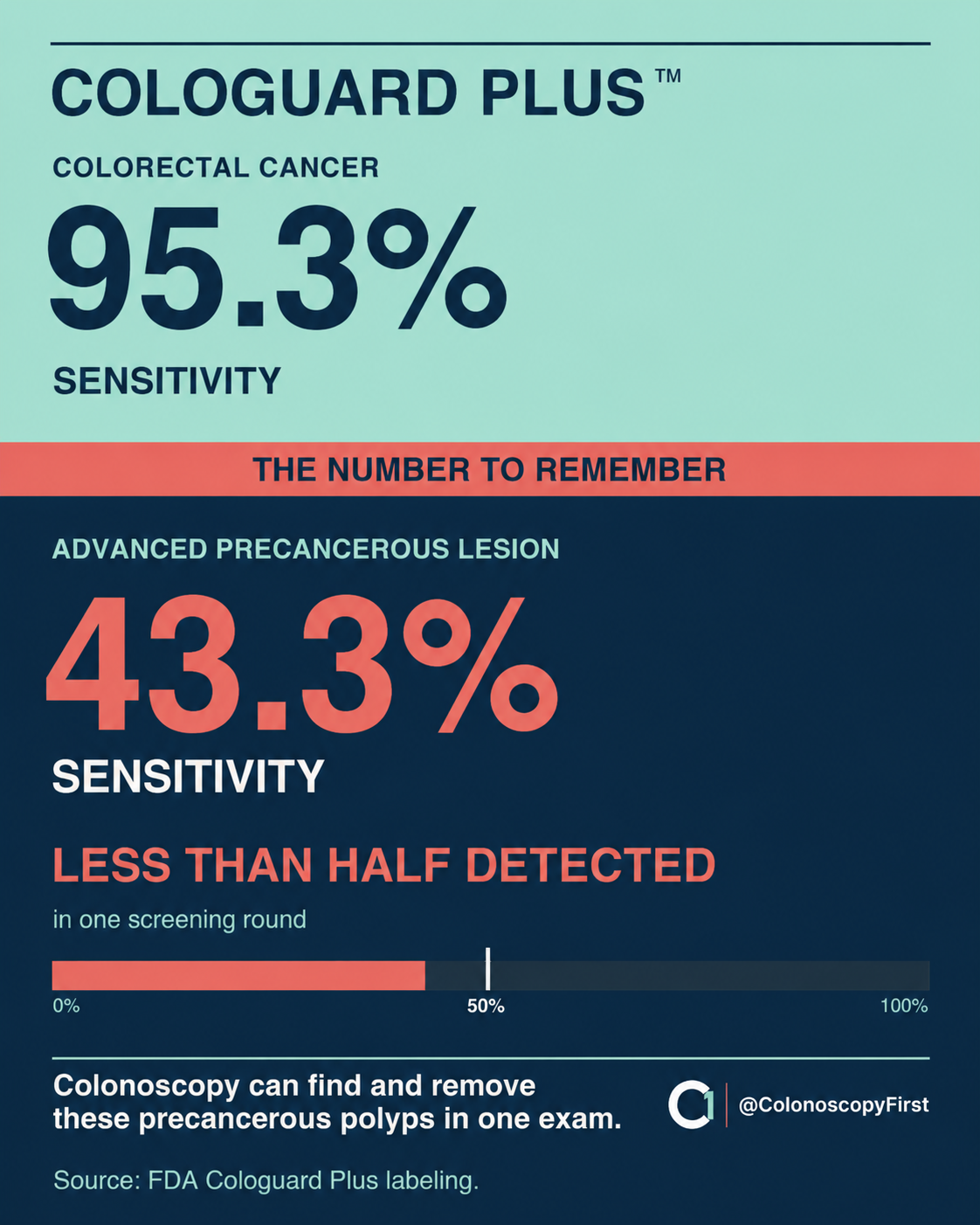
FDA Cologuard Plus labeling reports 95.3% colorectal-cancer sensitivity (81 of 85 people with cancer) and 43.3% advanced-precancer sensitivity (849 of 1,962 people with advanced precancer), in one screening round. These figures use the FDA primary-effectiveness population, not the published BLUE-C analysis set.
BLUE-C was funded by Exact Sciences, maker of Cologuard Plus; multiple published-study authors were company employees. Single-round test performance does not establish lifetime screening outcomes.
Colonoscopy can find and remove detected precancerous polyps during the same exam. It can also miss lesions and has preparation, sedation, bleeding, perforation, and other burdens or risks. Stool-based screening remains a guideline-supported option; a positive stool test requires colonoscopy. Choose a screening plan you can complete with your clinician.

Some polyps can develop into cancer. Finding and removing detected precancerous polyps is an opportunity for prevention; not every polyp becomes cancer, and colonoscopy does not prevent every cancer.
Colonoscopy can find and remove detected precancerous polyps during the same exam. It can also miss lesions and has preparation, sedation, bleeding, perforation, and other burdens or risks. Stool-based screening remains a guideline-supported option; a positive stool test requires colonoscopy. Choose a screening plan you can complete with your clinician.
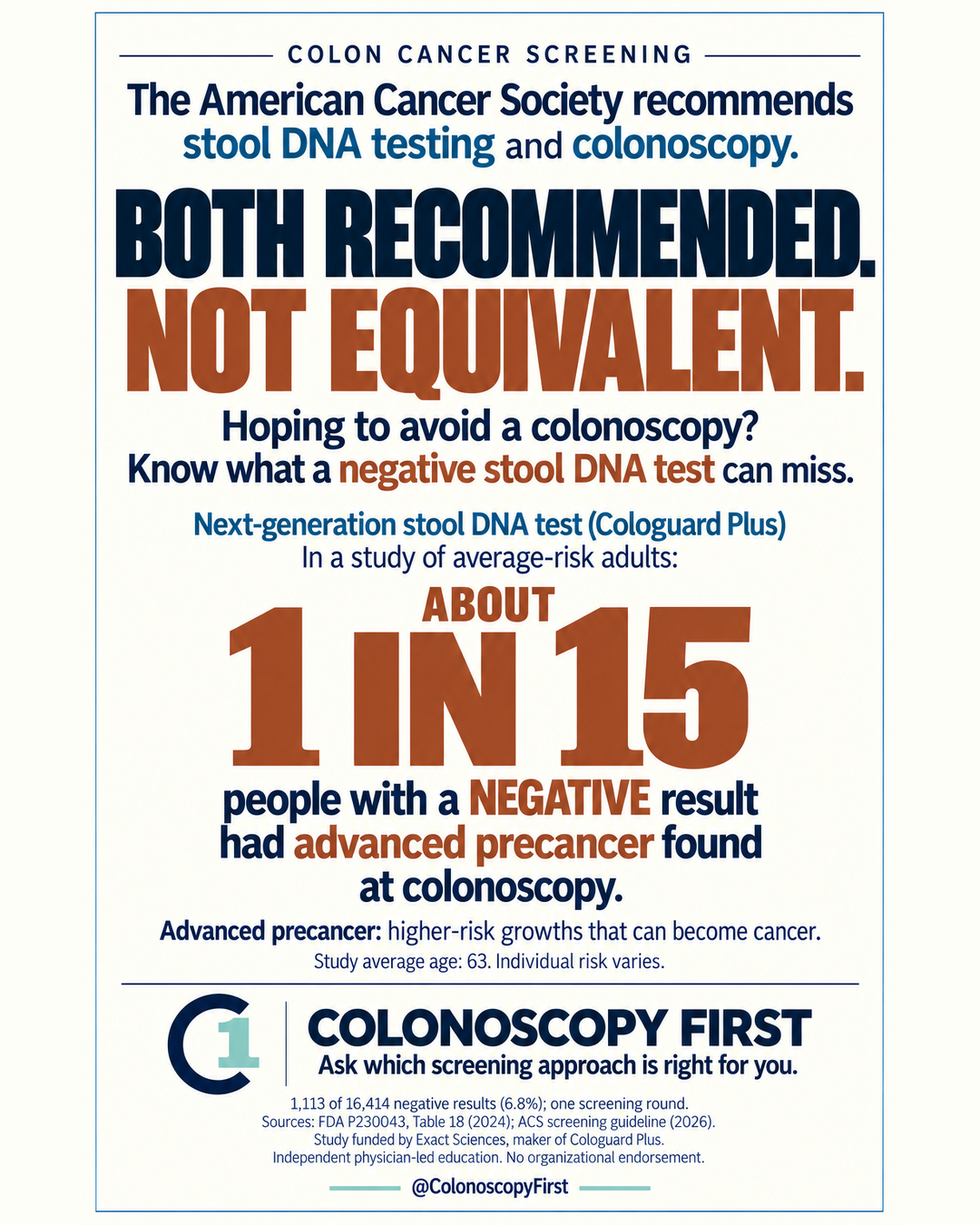
The American Cancer Society supports stool-based tests and colonoscopy for eligible average-risk adults, starting at age 45. Recommendation does not make the methods identical in detection, burdens, or polyp removal, and does not imply ACS endorsement of this campaign.
Among 16,414 negative Cologuard Plus results in the FDA analysis, 1,113 people had advanced precancer found at colonoscopy: 6.8%, or about 1 in 15. This is not sensitivity. Separately, 1,113 of 1,962 people who had advanced precancer tested negative (56.7%). The study population averaged 63 years of age; individual risk varies. A negative result does not automatically mean immediate colonoscopy is needed.
BLUE-C was funded by Exact Sciences, maker of Cologuard Plus; multiple published-study authors were company employees. Single-round test performance does not establish lifetime screening outcomes.
Colonoscopy can find and remove detected precancerous polyps during the same exam. It can also miss lesions and has preparation, sedation, bleeding, perforation, and other burdens or risks. Stool-based screening remains a guideline-supported option; a positive stool test requires colonoscopy. Choose a screening plan you can complete with your clinician.
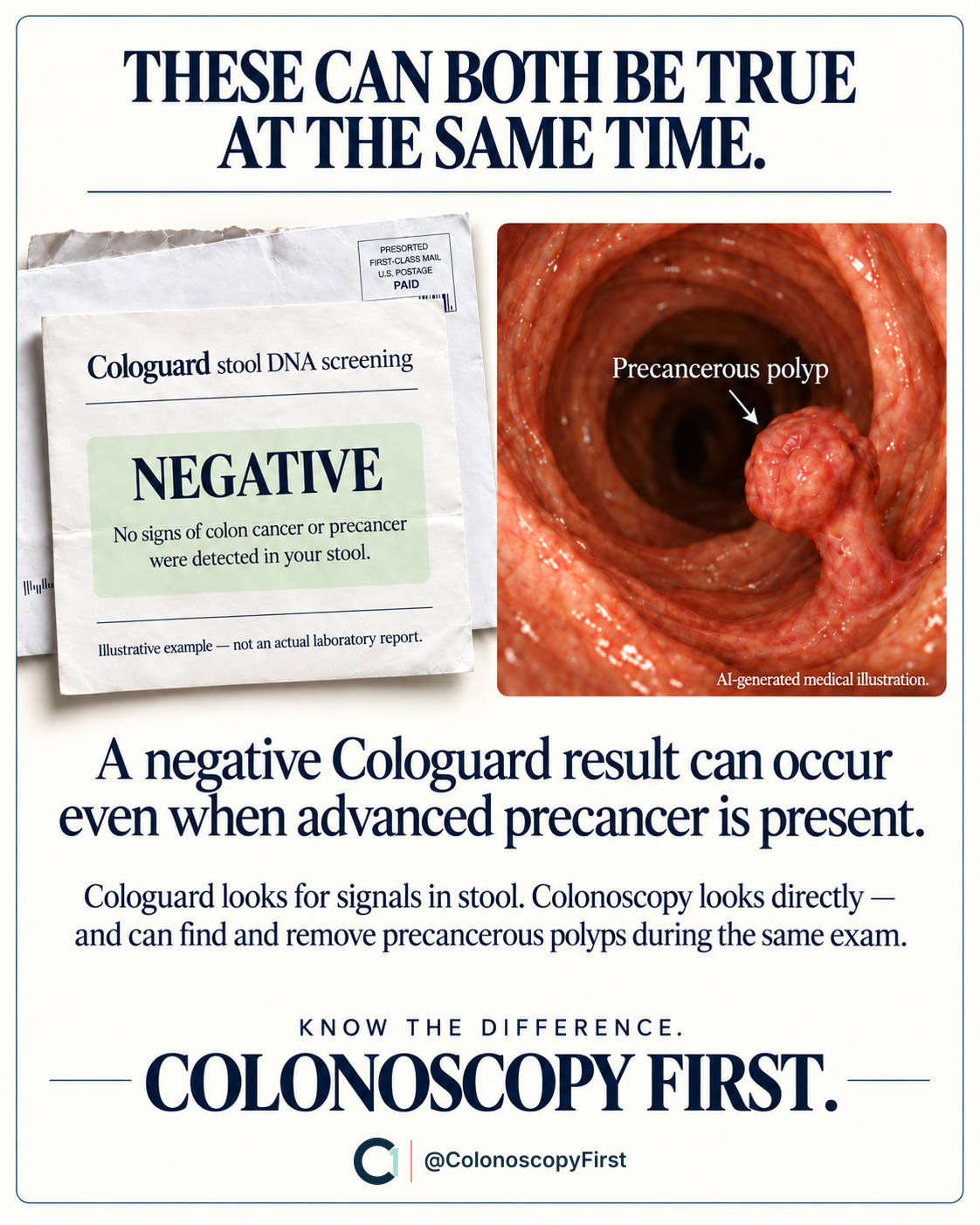
A negative stool DNA result can coexist with advanced precancer. The report shown is an illustrative example, not an actual laboratory report; the polyp image is labeled an AI-generated illustration.
Among 16,414 negative Cologuard Plus results in the FDA analysis, 1,113 people had advanced precancer found at colonoscopy: 6.8%, or about 1 in 15. This is not sensitivity. Separately, 1,113 of 1,962 people who had advanced precancer tested negative (56.7%). The study population averaged 63 years of age; individual risk varies. A negative result does not automatically mean immediate colonoscopy is needed.
BLUE-C was funded by Exact Sciences, maker of Cologuard Plus; multiple published-study authors were company employees. Single-round test performance does not establish lifetime screening outcomes.
Colonoscopy can find and remove detected precancerous polyps during the same exam. It can also miss lesions and has preparation, sedation, bleeding, perforation, and other burdens or risks. Stool-based screening remains a guideline-supported option; a positive stool test requires colonoscopy. Choose a screening plan you can complete with your clinician.
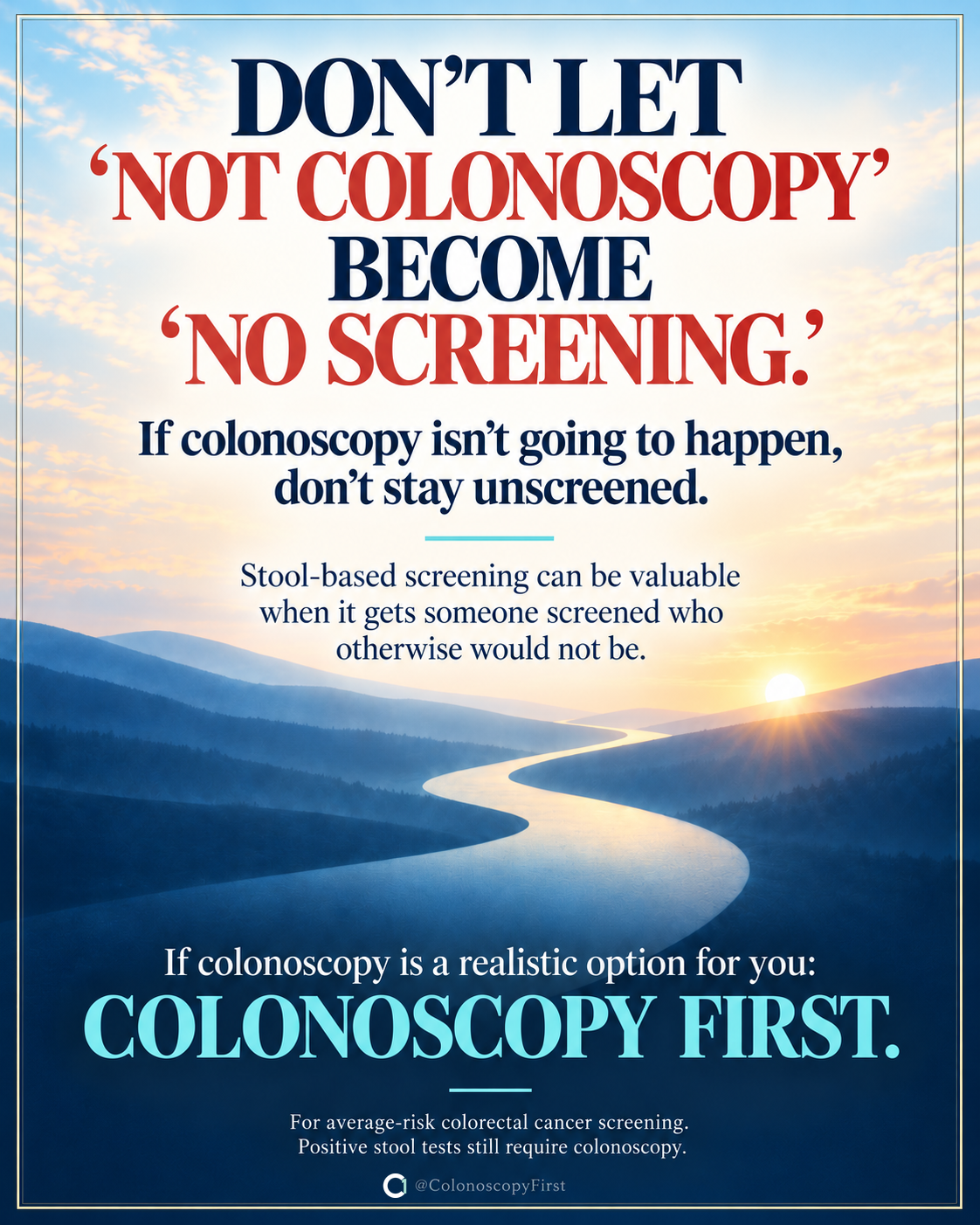
If colonoscopy is not going to happen, do not stay unscreened. Stool-based screening can be valuable when it gets someone screened who otherwise would not be.
The American Cancer Society supports stool-based tests and colonoscopy for eligible average-risk adults, starting at age 45. Recommendation does not make the methods identical in detection, burdens, or polyp removal, and does not imply ACS endorsement of this campaign.
Organized FIT programs demonstrate the value of participation, repeat testing, and completed colonoscopy follow-up. FIT is a stool blood test; its program outcomes cannot automatically be attributed to stool DNA testing.
Colonoscopy can find and remove detected precancerous polyps during the same exam. It can also miss lesions and has preparation, sedation, bleeding, perforation, and other burdens or risks. Stool-based screening remains a guideline-supported option; a positive stool test requires colonoscopy. Choose a screening plan you can complete with your clinician.

He cut every hair he could see. He never took off the hat.
This fictional visual analogy highlights direct examination and polyp removal. It is not a clinical comparison of screening outcomes. A stool DNA test can detect signals without seeing inside the colon; it cannot remove a polyp.
Colonoscopy can find and remove detected precancerous polyps during the same exam. It can also miss lesions and has preparation, sedation, bleeding, perforation, and other burdens or risks. Stool-based screening remains a guideline-supported option; a positive stool test requires colonoscopy. Choose a screening plan you can complete with your clinician.
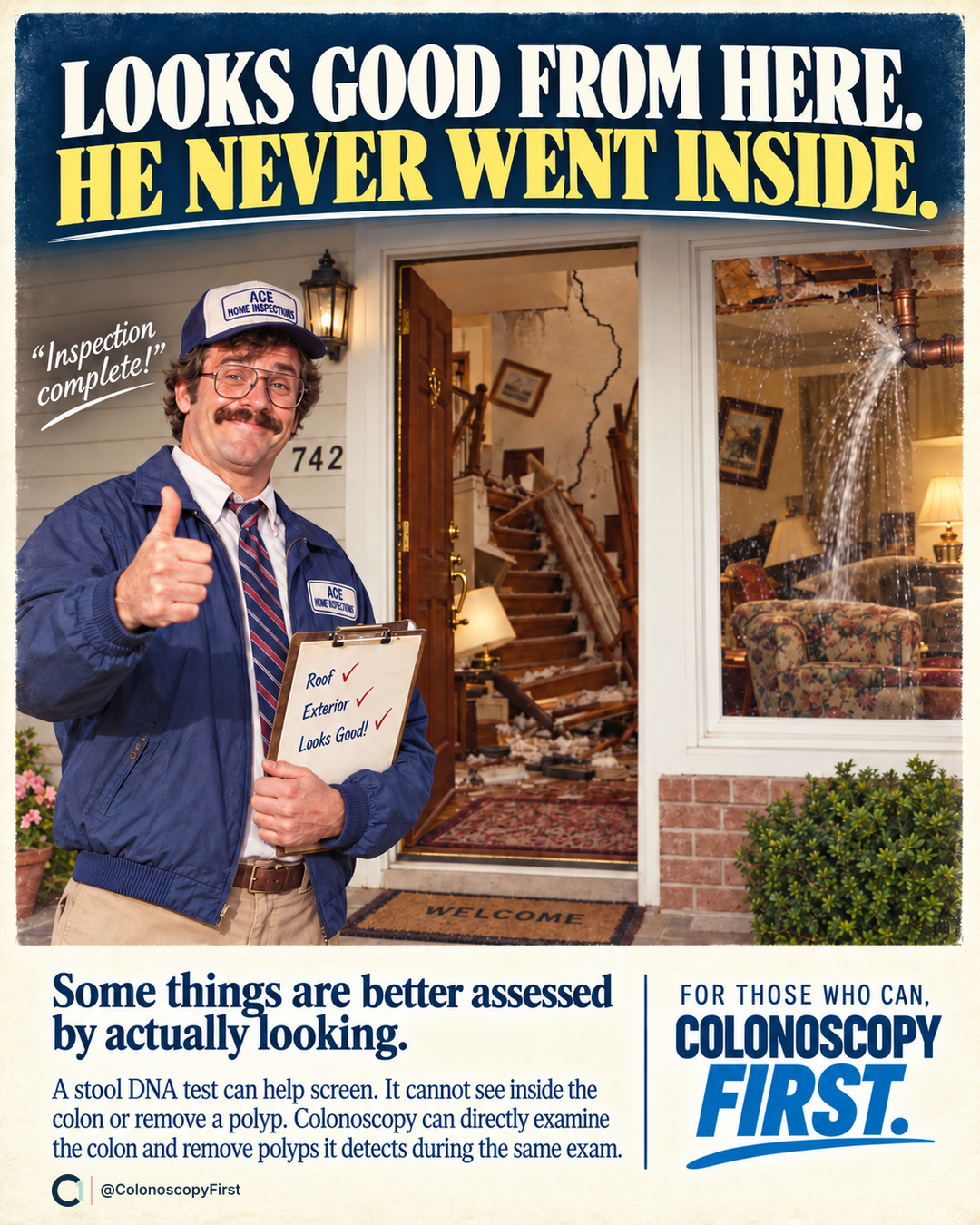
Looks good from here. He never went inside.
This fictional visual analogy highlights direct examination and polyp removal. It is not a clinical comparison of screening outcomes. A stool DNA test can detect signals without seeing inside the colon; it cannot remove a polyp.
Colonoscopy can find and remove detected precancerous polyps during the same exam. It can also miss lesions and has preparation, sedation, bleeding, perforation, and other burdens or risks. Stool-based screening remains a guideline-supported option; a positive stool test requires colonoscopy. Choose a screening plan you can complete with your clinician.

He checked the clothes. Never checked the fit.
This fictional visual analogy highlights direct examination and polyp removal. It is not a clinical comparison of screening outcomes. A stool DNA test can detect signals without seeing inside the colon; it cannot remove a polyp.
Colonoscopy can find and remove detected precancerous polyps during the same exam. It can also miss lesions and has preparation, sedation, bleeding, perforation, and other burdens or risks. Stool-based screening remains a guideline-supported option; a positive stool test requires colonoscopy. Choose a screening plan you can complete with your clinician.
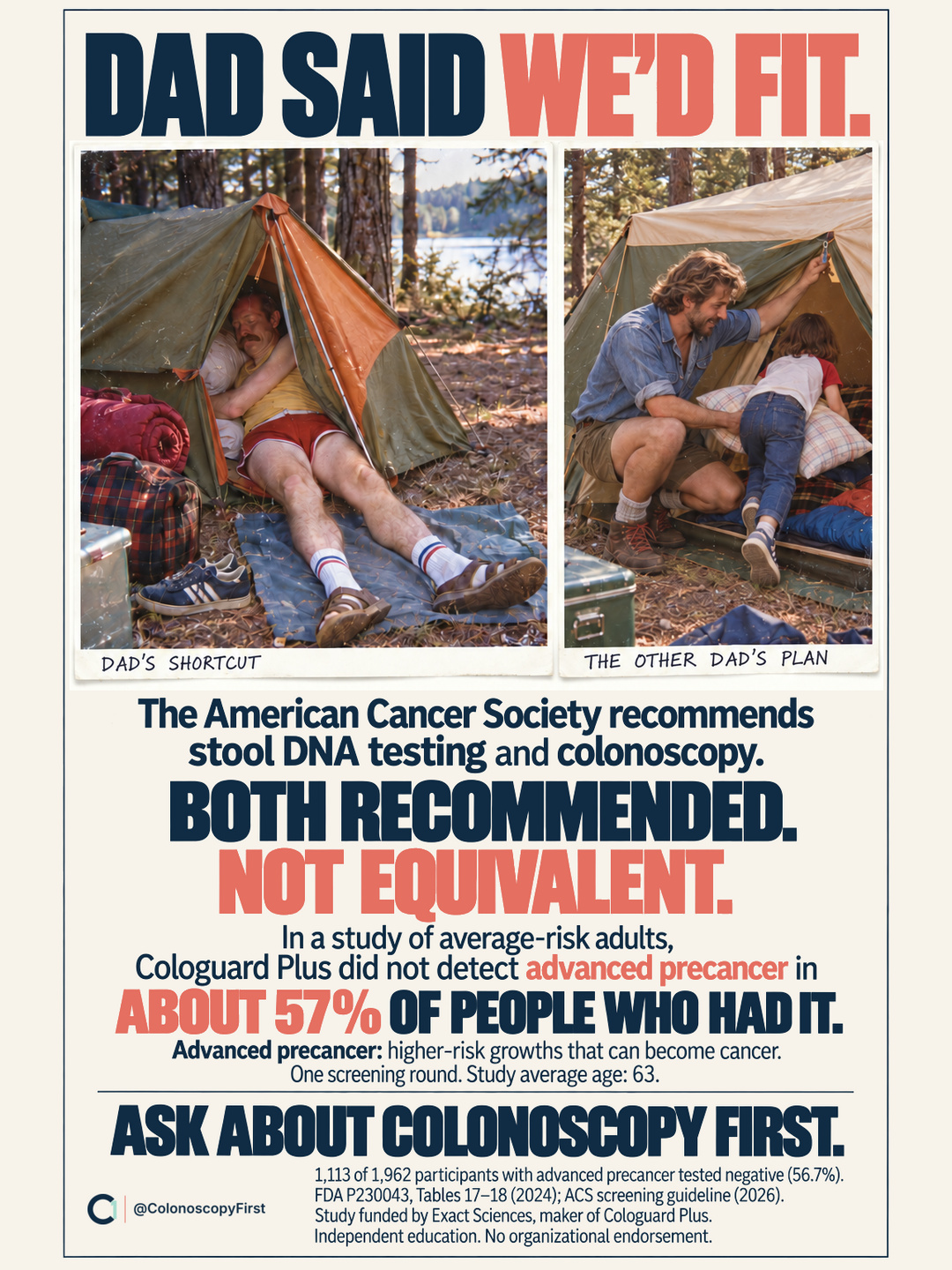
We remember Dad’s confidence. And the part of him outside the tent.
Both recommended does not mean equivalent in every respect. The American Cancer Society includes stool DNA testing and colonoscopy among screening options for eligible average-risk adults.
In the FDA-reviewed Cologuard Plus study, 1,113 of 1,962 participants with advanced precancer tested negative: 56.7%, or about 57%, in one screening round. Colonoscopy and histopathology supplied the reference findings.
This is the percentage of participants who had advanced precancer whose stool DNA test was negative. It is not the percentage of all screened adults with missed disease, a cancer miss rate, or the chance that a negative result conceals advanced precancer.
Colonoscopy can directly examine the colon and remove detected precancerous polyps. It can also miss lesions and involves preparation, logistical burdens and procedural risks. Stool DNA testing is a legitimate at-home option that requires repeat screening; a positive result needs follow-up colonoscopy. A negative stool result does not automatically mean an immediate colonoscopy is needed.
Colonoscopy First advocates high-quality colonoscopy for screening-eligible, average-risk adults who are medically appropriate, willing and have timely access. Ask your clinician about the tradeoffs and choose a screening plan you can complete.
The family scenes are fictional recreations. Independent physician-led education; no medical organization endorses this campaign.
BLUE-C was funded by Exact Sciences, maker of Cologuard Plus; multiple published-study authors were company employees. Single-round test performance does not establish lifetime screening outcomes.
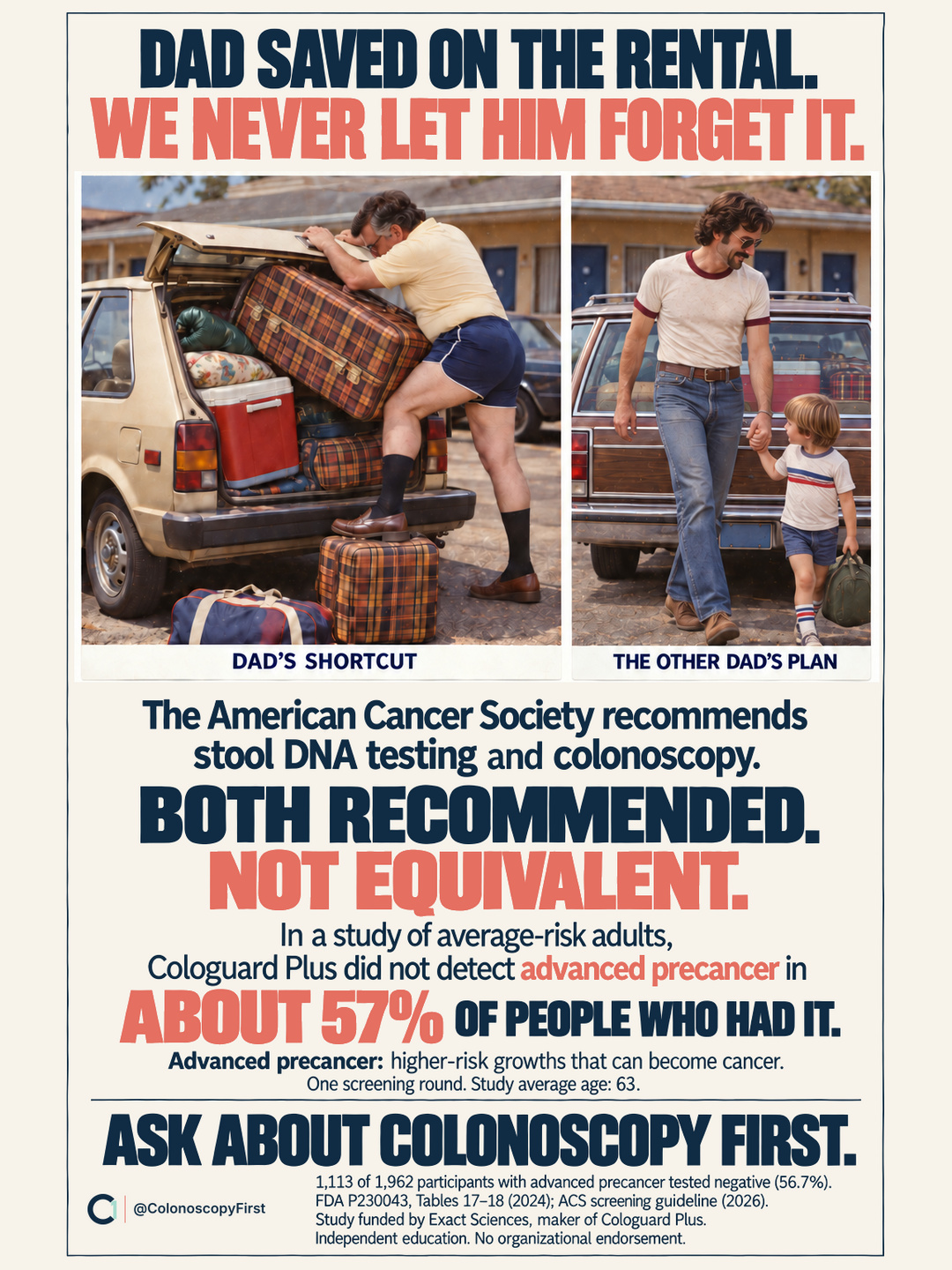
Dad chose the smaller rental. Packing became a problem for future Dad.
Both recommended does not mean equivalent in every respect. The American Cancer Society includes stool DNA testing and colonoscopy among screening options for eligible average-risk adults.
In the FDA-reviewed Cologuard Plus study, 1,113 of 1,962 participants with advanced precancer tested negative: 56.7%, or about 57%, in one screening round. Colonoscopy and histopathology supplied the reference findings.
This is the percentage of participants who had advanced precancer whose stool DNA test was negative. It is not the percentage of all screened adults with missed disease, a cancer miss rate, or the chance that a negative result conceals advanced precancer.
Colonoscopy can directly examine the colon and remove detected precancerous polyps. It can also miss lesions and involves preparation, logistical burdens and procedural risks. Stool DNA testing is a legitimate at-home option that requires repeat screening; a positive result needs follow-up colonoscopy. A negative stool result does not automatically mean an immediate colonoscopy is needed.
Colonoscopy First advocates high-quality colonoscopy for screening-eligible, average-risk adults who are medically appropriate, willing and have timely access. Ask your clinician about the tradeoffs and choose a screening plan you can complete.
The family scenes are fictional recreations. Independent physician-led education; no medical organization endorses this campaign.
BLUE-C was funded by Exact Sciences, maker of Cologuard Plus; multiple published-study authors were company employees. Single-round test performance does not establish lifetime screening outcomes.
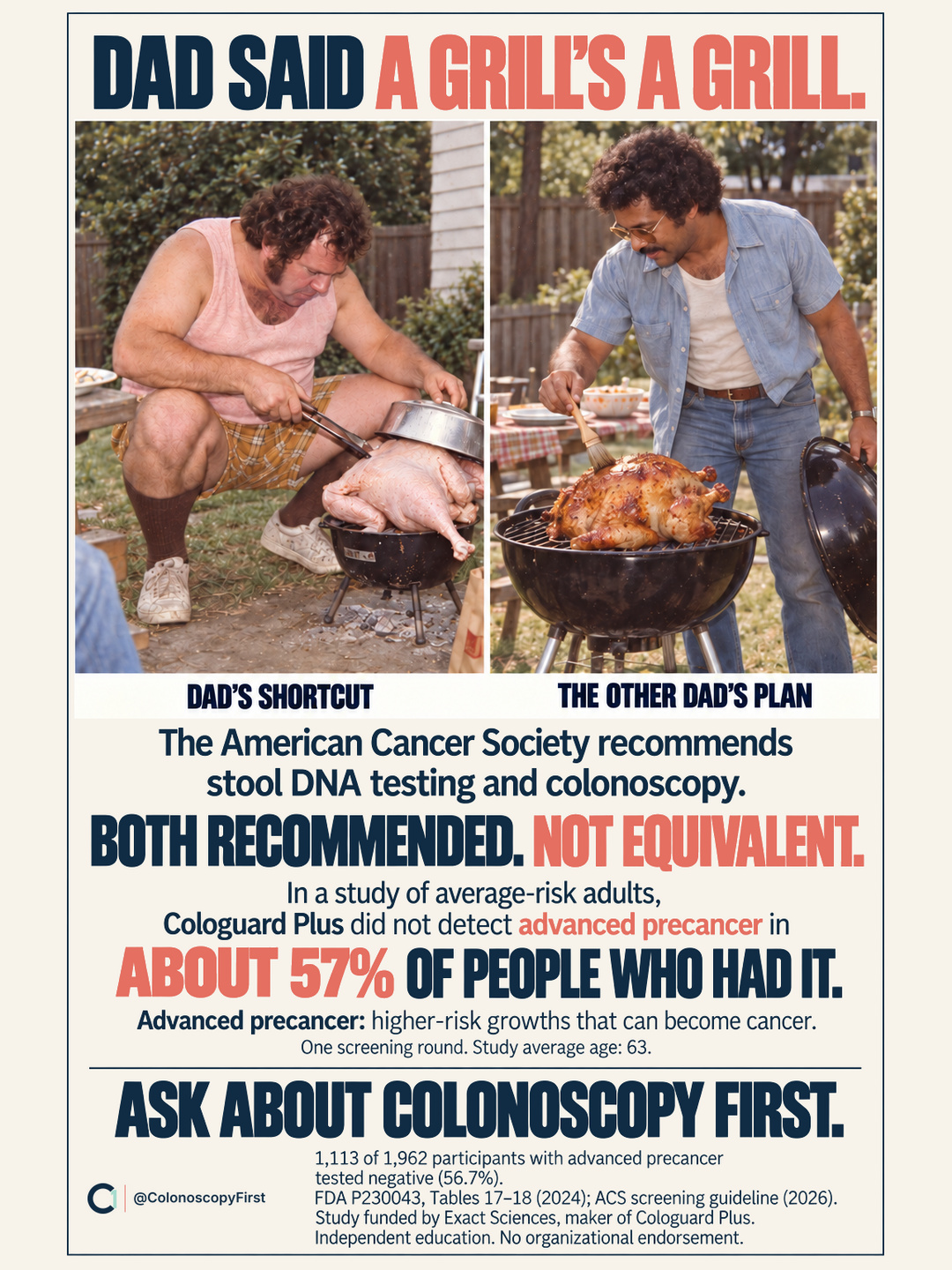
Dad was certain a grill was a grill. The turkey had other plans.
Both recommended does not mean equivalent in every respect. The American Cancer Society includes stool DNA testing and colonoscopy among screening options for eligible average-risk adults.
In the FDA-reviewed Cologuard Plus study, 1,113 of 1,962 participants with advanced precancer tested negative: 56.7%, or about 57%, in one screening round. Colonoscopy and histopathology supplied the reference findings.
This is the percentage of participants who had advanced precancer whose stool DNA test was negative. It is not the percentage of all screened adults with missed disease, a cancer miss rate, or the chance that a negative result conceals advanced precancer.
Colonoscopy can directly examine the colon and remove detected precancerous polyps. It can also miss lesions and involves preparation, logistical burdens and procedural risks. Stool DNA testing is a legitimate at-home option that requires repeat screening; a positive result needs follow-up colonoscopy. A negative stool result does not automatically mean an immediate colonoscopy is needed.
Colonoscopy First advocates high-quality colonoscopy for screening-eligible, average-risk adults who are medically appropriate, willing and have timely access. Ask your clinician about the tradeoffs and choose a screening plan you can complete.
The family scenes are fictional recreations. Independent physician-led education; no medical organization endorses this campaign.
BLUE-C was funded by Exact Sciences, maker of Cologuard Plus; multiple published-study authors were company employees. Single-round test performance does not establish lifetime screening outcomes.